
Hearing Care
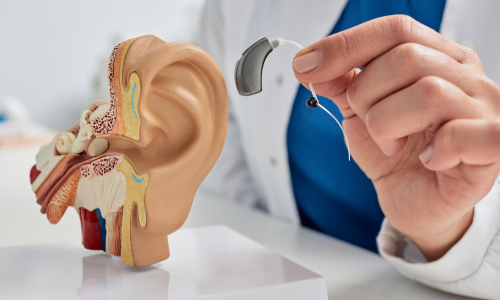
Understand Ear and Sound
Additionally, human ears act as a natural warning system. It is capable of identifying oncoming traffic, processing a possible break-in, alerting when there are other possible dangers, etc. Thus, hearing is a critical human sense and we must not wait until we experience hearing loss in order to remind us about its importance.
Life is not worth living without the sounds and voices that matter!

Ear
- The outer ear (pinna, ear canal and eardrum)
- The middle ear (the ossicular chain)
- The inner ear (semicircular canal cochlea)
The outer ear collects the sound waves and transmits them towards the eardrum, or tympanum. The tympanum vibrates and these vibrations are carried inside and amplified further by the ossicular chain. Further amplification takes place in the inner ear and the sensations are taken to the brain for analysis.

Sound travels as waves of pressure through air at a speed of 740 miles (approx. 1184 km) per hour. There are two features of sound that we can measure — pitch and intensity.
Pitch, also known as frequency, is a measure of how rapidly the waves change from above to below the ambient pressure. In other words, it is a measure of how many crests pass a point in a second. The greater the number, the higher is the pitch.
Intensity (loudness or amplitude) is a measure of how far the waves are above or below the ambient pressure. The greater the amplitude, the louder is the sound. Pressure levels of sound are measured as decibels (dB).
Hearing Loss Overview
Hearing disability can be congenital (from birth) or acquired (through a loud work environment). It can be managed through mechanical hearing devices or surgical interventions.
While a hearing disability is looked upon as a social stigma, it must be discussed and acted upon. Because, many times, acquired hearing disabilities can get worse with time. As hearing abilities get worse, people start experiencing problems with everyday life, like driving in the traffic, daily communication, etc. This can cause depression, frustration and other emotional problems. Hence, timely intervention in hearing impairment is very important.
- Normal (0 to 20 dBhL)
- Mild (cannot hear below 40 dBhL)
- Moderate (cannot hear below 60 dBhL)
- Moderately severe (cannot hear below 75 dBhL)
- Severe (cannot hear below 75 – 90 dBhL)
- Profound (cannot hear 90+ dBhL)
There Are Three Main Types Of Hearing Loss

Conductive Hearing Loss
Causes Conductive Hearing Loss
- Malformation of outer and middle ear structures
- Could be hereditary or can occur during an accident
- Accumulation of fluid in the ear canal
- Ear infections like otitis media
- Perforated eardrum(s)
- Allergies
- Benign tumors
- Impacted earwax obstructing passage of sound
- Infection of the ear canal
- Presence of foreign bodies

Sensorineural Hearing Loss
CAUSES Sensorineural Hearing Loss
- Before or during birth
- Lack of oxygen at the time of birth
- Heredity
- Infections such as rubella, herpes, toxoplasmosis, syphilis, cytomegalovirus (CMV)
- Later onset
- Bacterial meningitis
- Drug-induced ototoxicity
- Intense noise
- Physical damage to the head or ear
MIXED Hearing Loss
Blogs

What is a hearing aid? What is the use of hearing aids?
What is a hearing aid? We all have seen different hearing aids that are...

Deafness and hearing loss
What is the difference between deafness and hearing loss? When we talk about...
Link Between Covid-19 and hearing loss
Does Covid-19 cause hearing loss? When we talk about Novel Coronavirus, we...

How can we solve the hearing problem?
When an individual is suffering from hearing loss, the best solution available...